
Stretching Does More Than Make You Flexible
Most people book a stretch session for one reason: they want to move better. Touch their toes. Get their hips open again. Stop feeling like their shoulders are glued in place.
Nothing wrong with that! But a growing body of research suggests flexibility is only one of the benefits of stretching. A recent opinion paper published in Sports Medicine by a group of researchers who specialize in stretching, makes the point that stretching and flexibility training are not the same thing, and stretching's effects reach beyond how far a joint can move.

Flexibility Is One Piece, Not the Whole Picture
The researchers point out something practitioners often blur together. Range of motion, the total movement available at a joint, depends on a mix of factors: bone and joint structure, balance, how the nervous system coordinates muscles around a joint, pain tolerance, and soft tissue extensibility. Flexibility refers specifically to that last piece, the ability of soft tissue to lengthen.
Stretching is one way to influence flexibility. Strength training through a full range of motion and foam rolling also influence flexibility. This is exactly why we offer strength training in addition to our stretching services. They enhance each other.
What Else the Research Points To
Research on static stretching and its relationship to arterial stiffness connects consistent stretching practice to measures relevant to cardiovascular health over time.

Strength and muscle growth. Reviews cited in the paper link stretching to gains in muscle strength and hypertrophy, likely through the same mechanical tension that drives adaptation in resistance training. Stretching and strength work may share more physiological overlap than most people assume. If hypertrophy is the goal, strength training will get you there faster, but for people who can't strength train, research suggests that longer, more frequent, higher intensity stretching can still produce a small amount of muscle growth.
Reduced muscle and nerve stiffness. Several studies show that consistent stretching over time can lower stiffness in muscle tissue, and there's early evidence it may affect nerve stiffness as well. This lines up with what clients often describe after a stretching routine: less tension, easier movement, even days after the session.

Reduced pain perception. The paper cites research on what's sometimes called stretch-induced hypoalgesia, meaning stretching has been associated with a measurable dip in how much pain people report immediately afterward. This doesn't mean stretching treats an injury or replaces medical care. It means stretching has an effect on perceived pain discomfort.
Why This Matters for How We Work With You
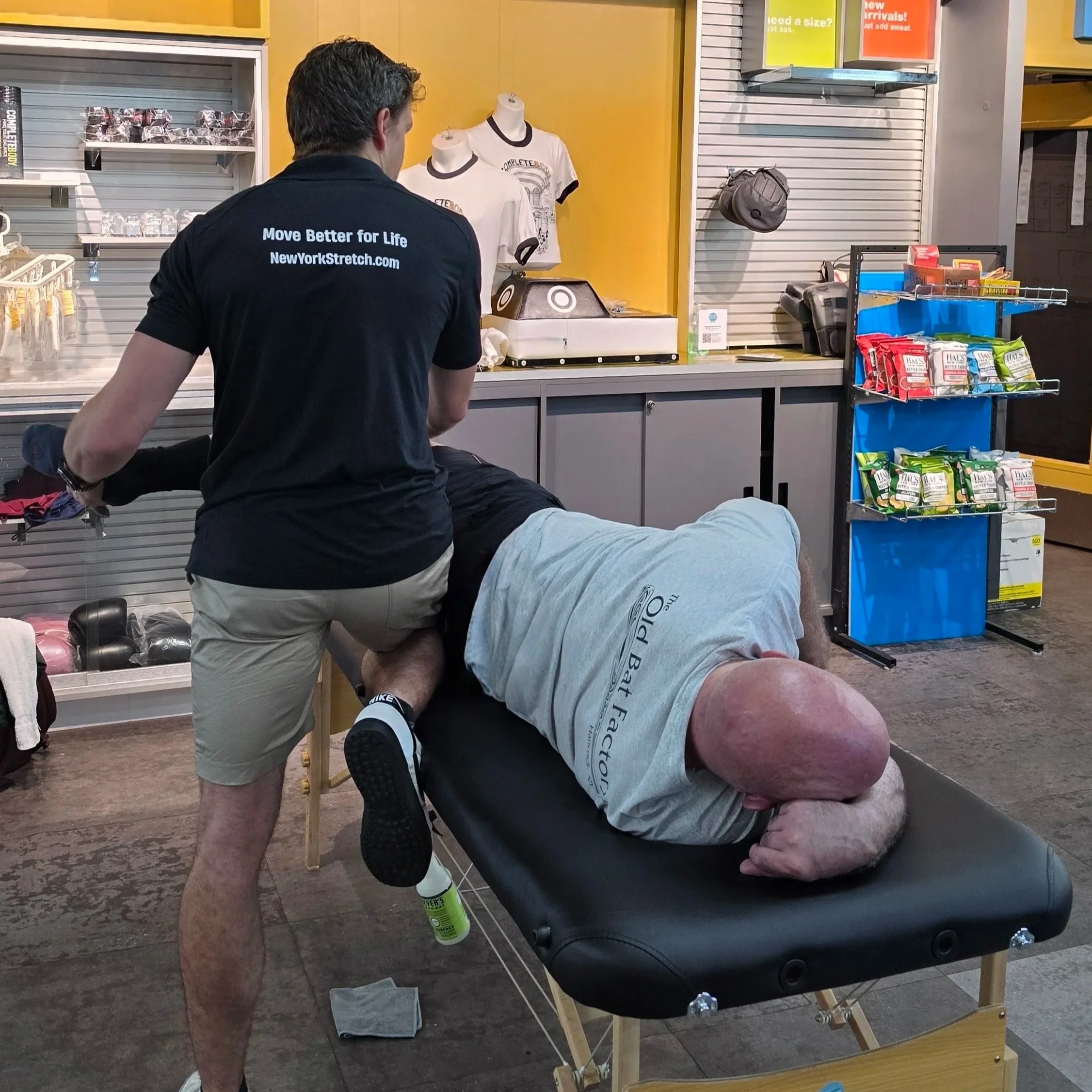
This research is about static stretching broadly, studied across a range of methods and settings. Assisted stretching is one way to apply it: a specialist moves you through stretches that you likely wouldn't reach on your own, on a schedule that makes it easier to stay consistent rather than a solo routine.
A single session will not lower your blood pressure or build muscle overnight. The research does suggest that stretching, done consistently, appears to touch more systems in the body than flexibility alone. That gives people another reason to treat stretching as a regular part of how they move and recover, not just something to do before a workout or after a long day at the desk.
If you've been coming in just for the flexibility, keep at it. The research suggests you're doing a lot more for your nervous system and overall health along the way, too.
Sources referenced: Afonso J, Blazevich AJ, Behm DG, Tilp M, Warneke K. "One of These Things Is Not Like the Others: Disentangling the Concepts of Range of Motion Versus Flexibility, and Flexibility Training Versus Stretching." Sports Medicine, 2026.